
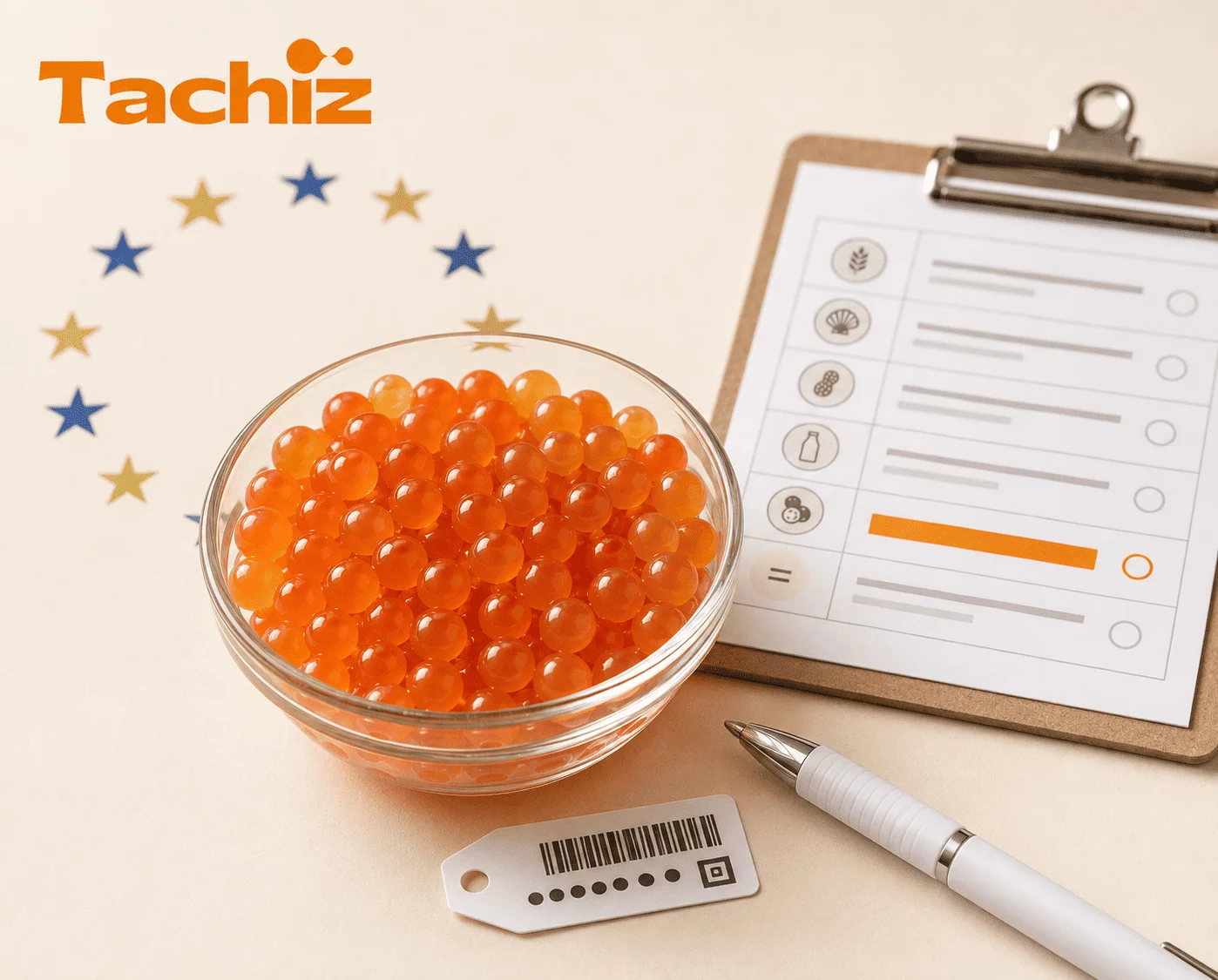
When exporting food products to the European market, complying with EU food allergen labelling regulations and maintaining robust supply-chain traceability are critical for food business operators. Linking ingredient batches with production records and finished-product lot numbers can further support customer audits, incident investigations, and product recalls.
For brands using popping boba in beverages, desserts, yogurt, or packaged foods, a general product specification sheet may not be enough. When customers or authorities request an investigation, the brand must be able to identify the ingredients and allergen documents associated with a specific production batch.
Which Food Allergens Are Regulated in the EU?
Under Regulation (EU) No 1169/2011, food products sold in the EU must clearly indicate the following 14 allergen categories when they are used as ingredients:
- Cereals containing gluten
- Crustaceans
- Eggs
- Fish
- Peanuts
- Soybeans
- Milk
- Nuts
- Celery
- Mustard
- Sesame
- Sulphur dioxide and sulphites
- Lupin
- Molluscs
For prepacked foods, the allergen name must normally be emphasised within the ingredients list using a clearly distinguishable typeface, style, or background colour.
If the product does not require an ingredients list, allergen information should be provided through an appropriate statement such as “Contains”.
Allergen Information Is Also Required for Non-Prepacked Foods
Restaurants, cafés, deli counters, and other businesses selling non-prepacked foods must also provide allergen information.
However, the method of providing this information may vary between EU Member States. In some situations, allergen information may be communicated verbally, but consumers must be clearly informed about how to obtain it, and written information must be available upon request.
This means businesses should not assume that every restaurant menu must display allergens in bold text. The applicable requirements should be confirmed according to the product format and the country where it will be sold.
Why EU Food Allergen Labelling Requires Batch Traceability
Article 18 of Regulation (EC) No 178/2002 establishes the EU’s general principles for food traceability.
To ensure full compliance with EU food allergen labelling rules, food business operators must maintain appropriate systems and records that allow them to identify:
-
The supplier of a food or ingredient
-
The business customer receiving the product
-
Relevant supplier, customer, and product information
This is commonly described as the “one step back, one step forward” traceability principle.
When an allergen labelling error, quality issue, or food safety incident occurs, effective traceability helps businesses verify compliant EU food allergen labelling records, identify affected products, and respond more quickly.
The regulation establishes a basic traceability obligation. Connecting each ingredient batch with production records and finished-product lot numbers provides an additional level of control that can support customer audits, investigations, and product recalls.

What Should Brands Confirm When Using Popping Boba?
Even when a popping boba formulation does not intentionally contain any of the EU’s 14 regulated allergens, businesses should not rely on a general “allergen-free” assumption.
Before introducing the ingredient into a finished product, brands should request and review:
- The latest product specification and complete ingredient information
- An allergen declaration and information about compound ingredients
- Cross-contact risks and the supplier’s allergen-control procedures
- Production dates, lot numbers, and storage requirements
- Batch-level testing or quality-control records
- Traceability and response procedures for product issues
The food business operator placing the final product on the market remains responsible for ensuring that the finished product is labelled correctly. The complete recipe, production process, quantity of each ingredient, and destination market should therefore be evaluated before sale.
How Does Tachiz Manage Product Traceability?
Tachiz has maintained FSSC 22000 certification since 2017 and implemented a Digiwin ERP system in 2021 to support order, production, and batch-data management.
Through systematic recordkeeping, the Tachiz team can trace relevant manufacturing information by product and lot number. This also supports the preparation of product specifications, allergen declarations, and batch-related documents when requested by customers.
For Tachiz, food safety is more than a certification. It is part of our daily work, from ingredient verification and document management to production control and traceability records.
Entering the EU market requires more than placing allergen information on a label. Ingredient documents, batch management, and supply-chain traceability all influence how effectively a brand can respond to customers and regulatory authorities.
If you are developing a beverage, dessert, ready-to-drink product, or packaged food containing popping boba, contact the Tachiz team to discuss product specifications, application testing, and export documentation requirements.
Frequently Asked Questions
Can popping boba be described as allergen-free?
A general allergen-free claim should not be based solely on the product category. Different flavours, formulations, and compound ingredients may have different allergen profiles. Always review the latest product specification, allergen declaration, and actual production conditions.
Is a general product specification sufficient for EU traceability?
A general specification explains the standard characteristics of a product. However, customer audits and food safety investigations may also require ingredient, production, and shipment records linked to a specific lot.
What information should be checked before exporting food to the EU?
In addition to allergen information, businesses may need to confirm the product name, ingredients, net quantity, storage instructions, date marking, nutrition information, responsible food business operator details, and other applicable requirements.
Language rules and requirements for non-prepacked foods may also differ between EU Member States.
Learn more about Tachiz:
https://tachizgroup.com/about-us/