
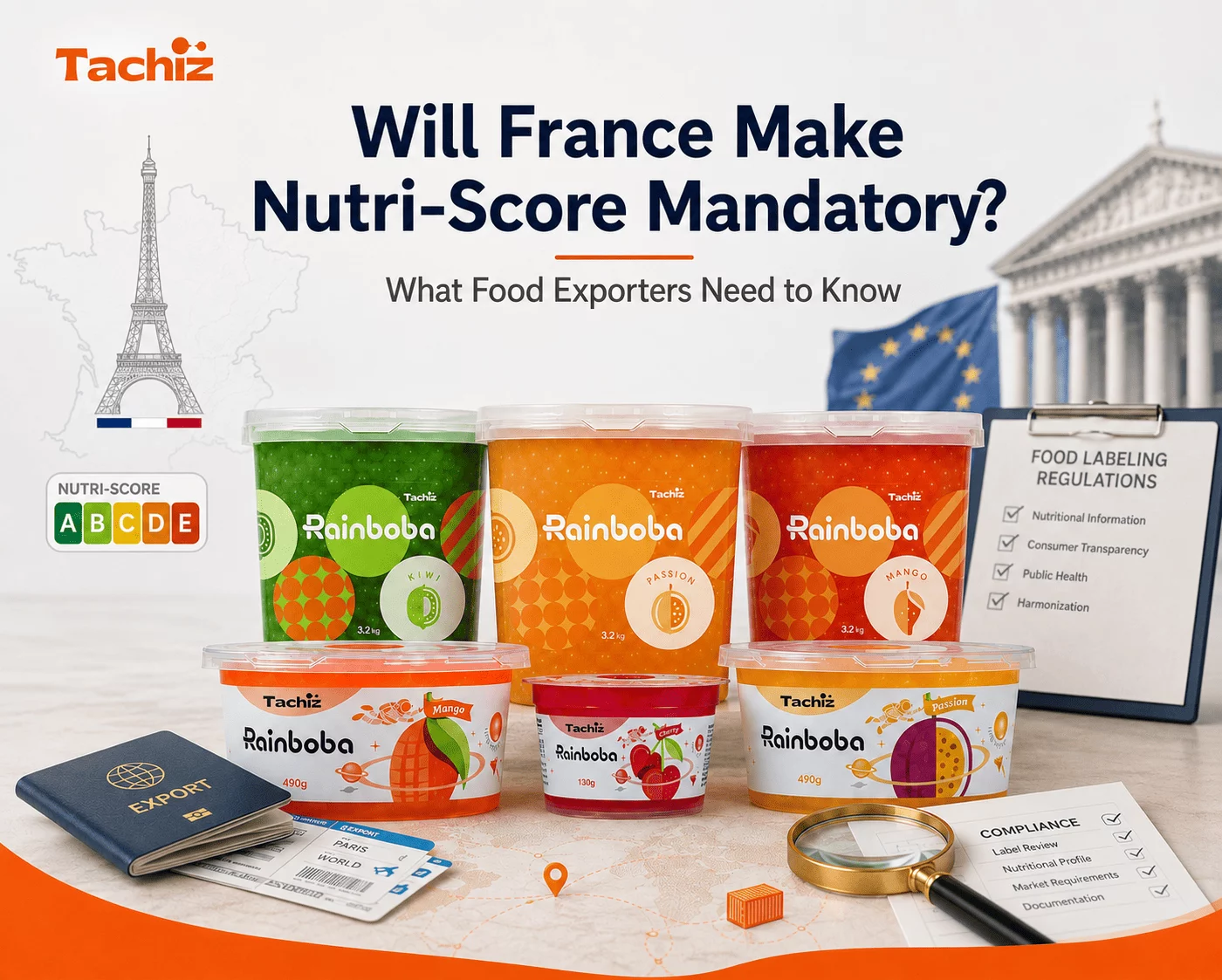
For food brands preparing to enter the French or European market, food regulations are not limited to ingredients and food additives.
Nutrition labeling is also becoming an increasingly important factor affecting product development, packaging design, and market strategy.
One important example is Nutri-Score, the front-of-pack nutrition labeling system that France has promoted for years.
In 2025, the French National Assembly adopted a proposal related to Nutri-Score. The proposal considered imposing a contribution equal to 5% of pre-tax turnover on certain food businesses that did not comply with relevant Nutri-Score display requirements.
Although the measure ultimately did not become law, the legislative process still sent an important signal:
France continues to push for greater transparency in food nutrition information, and Nutri-Score may become even more important in the food market.
What Is Nutri-Score?
Nutri-Score is a front-of-pack nutrition labeling system displayed on food packaging.
Consumers see five grades:
A, B, C, D, and E
These grades provide a quick indication of the overall nutritional profile of a food product.
The Nutri-Score calculation takes into account different nutritional factors, including:
- Energy
- Sugar
- Saturated fat
- Salt
- Fiber
- Protein
- Certain beneficial nutritional components
Compared with a traditional nutrition facts panel, Nutri-Score allows consumers to understand the overall nutritional profile of a product more quickly without having to read each nutrient value individually.
For food brands, this means that a product’s nutritional composition may increasingly influence the consumer’s first impression.
Is Nutri-Score Mandatory in France?
No, not currently.
As of 2026, Nutri-Score in France remains a government-recommended voluntary nutrition labeling system. It is not legally mandatory for all food products.
However, in 2025, France came relatively close to introducing measures that could have made Nutri-Score much more influential in practice.
During discussions on the 2026 Social Security Financing Bill, the French National Assembly adopted a provision related to Nutri-Score.
The proposed system did not simply state:
“Every food product must display Nutri-Score.”
Instead, it used a financial mechanism to create a strong incentive for businesses to adopt the labeling system.
Products Without Nutri-Score Could Have Faced a 5% Turnover Contribution
Under the proposal, food businesses falling within the relevant scope and not meeting certain Nutri-Score display requirements could have been required to pay a contribution equivalent to:
5% of pre-tax turnover
It is important to distinguish this from an administrative fine.
The more accurate legal term is contribution, meaning a financial levy or charge rather than a penalty.
For example, if a food company generated:
€1,000,000
in relevant pre-tax turnover in France, 5% would equal:
€50,000
Therefore, even if the proposed system did not formally make Nutri-Score mandatory, the potential financial cost could have created a very strong incentive for businesses to adopt it.
This is one reason why the proposal attracted significant attention within the French food industry.
Did the 5% Nutri-Score Contribution Become Law?
No.
On November 21, 2025, the French Senate rejected the relevant provision.
When the bill later returned to the National Assembly, there were attempts to restore the measure, but they were unsuccessful.
As a result, the final 2026 French Social Security Financing Law did not include the proposed 5% Nutri-Score contribution.
This means that, at present, there is no French rule stating that:
“A food company must pay 5% of its turnover simply because it does not display Nutri-Score.”
This distinction is important for food exporters planning to enter the French market.
Why Should Food Exporters Still Pay Attention?
Food regulations rarely change overnight.
New rules often develop gradually through policy discussions, legislative proposals, parliamentary debates, and formal implementation.
Although this Nutri-Score proposal did not become law, it demonstrates that some French policymakers are interested in strengthening food nutrition transparency.
For food exporters, the key question should therefore not only be:
“Is Nutri-Score mandatory today?”
It should also be:
“Where could French nutrition labeling policy be heading in the future?”
For brands developing new products, redesigning packaging, or planning a long-term presence in France, understanding these trends early can reduce the cost and complexity of future changes.
Nutri-Score May Influence Product Development
Nutri-Score is not simply another logo placed on packaging.
It may also influence product formulation.
Food brands may need to reassess factors such as:
- Sugar content
- Saturated fat
- Salt and sodium levels
- Fiber content
- Protein content
- Overall product positioning
If a product receives a lower Nutri-Score rating, such as D or E, a brand may need to consider whether to reformulate the product or adjust its market positioning.
As a result, nutrition labeling is gradually expanding beyond packaging compliance and becoming part of:
product development, brand positioning, and market communication.
Exporting Food to France Requires More Than EU Compliance
Another common misconception among international food brands is:
If a product complies with EU food regulations, the same market strategy can be used across every European country.
In practice, the situation is more complex.
The European Union has many harmonized food regulations, but individual countries may still adopt different approaches to areas such as:
- Nutrition labeling
- Front-of-pack labeling
- Food advertising
- Public health policies
- Sustainability labeling
- Consumer information
France’s strong promotion of Nutri-Score is a clear example.
Therefore, when planning:
Taiwan-to-France food exports
or broader European market expansion, brands should not only verify baseline EU regulatory requirements but also understand the policies and market expectations of the specific country where the product will be sold.
Food Exporters Need to Consider Both Regulation and Market Trends
For food companies, regulatory compliance is only the first step toward entering a market.
A strong international product development strategy should also consider:
What do current regulations allow?
What do retailers require?
What are consumers increasingly concerned about?
How might future regulations change?
If nutrition labeling or product formulation issues are discovered only after the product has been finalized, packaging has been printed, or shipments are already being prepared, redesigning and retesting can create additional costs.
For this reason, identifying the destination market early in the product development process is an important part of international food export planning.
How Does Tachiz Respond to Different Market Requirements?
Tachiz works with food brands, importers, and product development partners from different international markets.
Each market may have different requirements regarding ingredients, product specifications, labeling, and consumer expectations.
For this reason, we believe:
A product designed for the global market should consider not only the product itself, but also the destination market from the beginning.
From food additives to nutrition labeling, market regulations continue to evolve.
Tachiz continues to monitor developments in international food markets and relevant regulatory trends, while working with customers to discuss suitable product development directions based on their target market, brand positioning, and product requirements.
For food brands preparing to enter France, the European Union, or other international markets, considering both market expectations and regulatory requirements early can help reduce the risk of costly adjustments later.
FAQ: France Nutri-Score
Is Nutri-Score mandatory in France?
No. As of 2026, Nutri-Score remains a government-recommended voluntary nutrition labeling system in France. It is not legally mandatory for all food products.
Will companies be charged 5% of turnover if they do not display Nutri-Score?
Not under current law. France considered a proposal in 2025 involving a contribution based on 5% of pre-tax turnover for certain businesses that did not meet relevant Nutri-Score display requirements, but the provision ultimately did not become law.
How is Nutri-Score calculated?
Nutri-Score evaluates the overall nutritional composition of a food product. Factors may include energy, sugar, saturated fat, salt, fiber, protein, and other nutritional components. The final result is displayed as a grade from A to E.
Do food products exported to France have to display Nutri-Score?
Not all food products are currently legally required to use Nutri-Score. However, food exporters should still check the latest French and EU labeling regulations, as well as requirements from importers, retailers, and individual brands.
Why should food exporters continue to monitor Nutri-Score?
Nutri-Score may affect more than packaging design. It can influence product formulation, nutrition strategy, and how consumers perceive a product. France’s 2025 legislative proposal also shows that front-of-pack nutrition labeling may continue to evolve.
Learn more about Tachiz:
https://tachizgroup.com/about-us/