
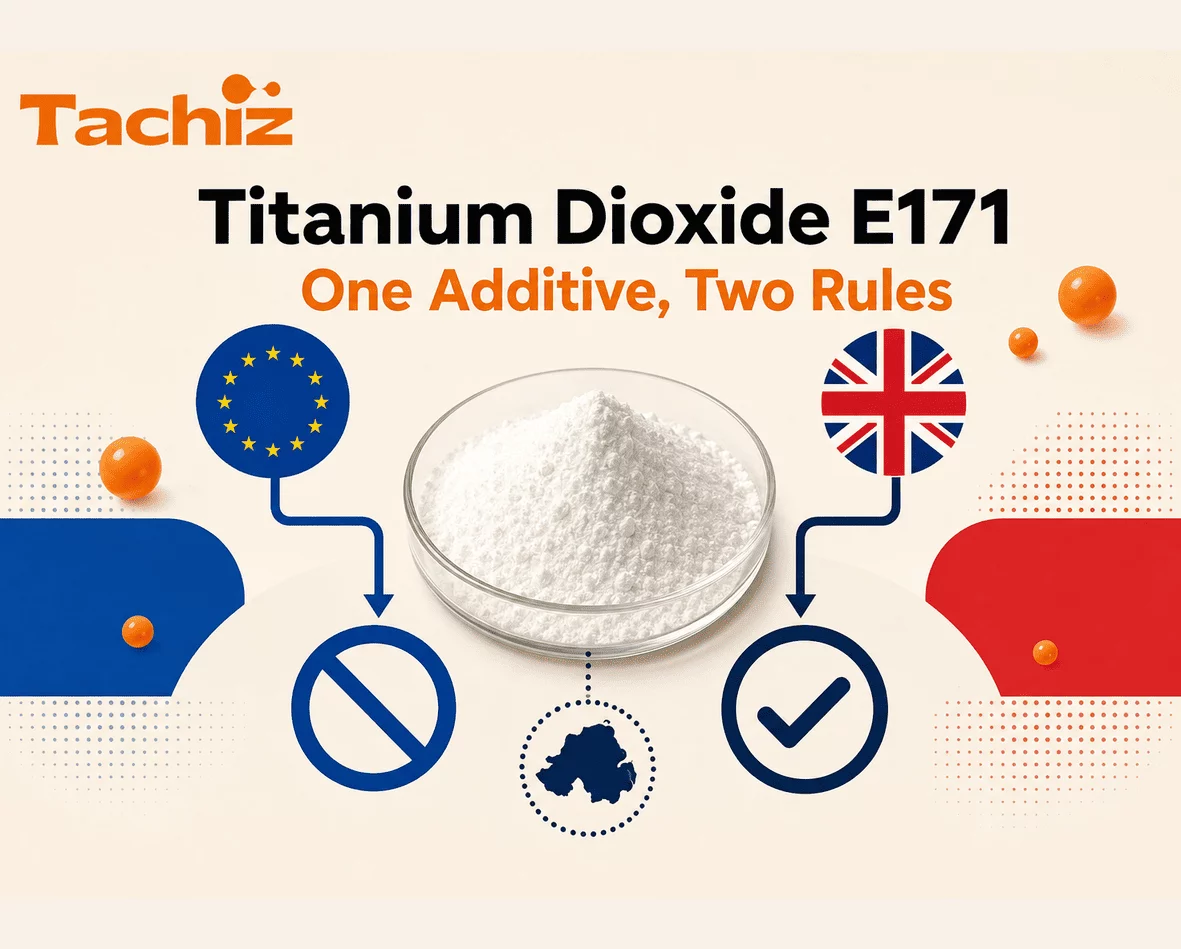
The same food additive can be subject to different rules in the European Union and Great Britain.
Since 2022, titanium dioxide E171 has no longer been permitted as a food additive in the EU. However, current official data in Great Britain still lists E171 as an authorised food additive.
This difference highlights an important point for food exporters: Europe is not a single regulatory market. The EU, Great Britain, and Northern Ireland do not follow exactly the same rules. Product development should therefore not rely on one formulation for every market. Each destination must be reviewed individually.
What Is Titanium Dioxide E171?
Titanium dioxide has the chemical formula TiO₂ and is identified as E171 in the food additive numbering system.
According to the European Food Safety Authority, or EFSA, E171 was previously authorised for use as a food colour. Technical information published by EFSA describes it as a white powder that is insoluble in water and organic solvents. It has been used in products such as confectionery, chewing gum, icing, pastries, certain dairy products, and sauces.
Why Did the EU Ban Titanium Dioxide E171?
In 2021, EFSA reassessed the safety of titanium dioxide E171 as a food additive.
Based on the scientific evidence available at the time, EFSA concluded that concerns about the potential genotoxicity of titanium dioxide particles could not be ruled out. EFSA was also unable to establish an Acceptable Daily Intake.
As a result, EFSA concluded that E171 could no longer be considered safe when used as a food additive.
It is important to interpret this conclusion accurately. It does not mean that EFSA proved ordinary dietary exposure will inevitably cause a specific disease. Rather, the available evidence was not sufficient to rule out the relevant safety concerns or continue confirming E171 as safe for use as a food additive.
When Did the EU Ban Take Effect?
In January 2022, the European Commission adopted Commission Regulation (EU) 2022/63, withdrawing the authorisation of titanium dioxide E171 as a food additive.
The regulation included a six-month transition period. After this period ended on 7 August 2022, E171 could no longer be used as a food additive in foods subject to EU regulations.
Products intended for Germany, France, Italy, Spain, the Netherlands, Belgium, or any other EU Member State must therefore comply with the EU requirements for E171.
Is E171 Still Permitted in Great Britain?
As of August 2026, the Food Standards Agency’s register of authorised regulated food and feed products continues to list titanium dioxide E171 as authorised in England, Scotland, and Wales, which together form Great Britain.
However, authorised does not mean that E171 can be added freely to every type of food. Food businesses must still check the applicable legislation to confirm whether the additive is permitted in a specific food category and whether any conditions or quantitative limits apply.
How Do the Rules in Northern Ireland Differ?
Great Britain and Northern Ireland should not be treated as the same food regulatory area.
UK government guidance updated in 2026 states that titanium dioxide has not been permitted as a food additive in food manufacturing in Northern Ireland since 7 February 2022. Following the end of the six-month transition period on 7 August 2022, E171 could no longer be used to manufacture food in Northern Ireland.
The current market distinctions can be summarised as follows:
- European Union: E171 is not permitted for use as a food additive.
- Great Britain: E171 remains listed as an authorised food additive.
- Northern Ireland: E171 may not be used in local food manufacturing.
UK government guidance also states that certain goods containing titanium dioxide that are authorised in Great Britain may enter Northern Ireland through the Northern Ireland Retail Movement Scheme, or NIRMS.
This special arrangement does not mean that Northern Ireland has reauthorised E171 for local food manufacturing. Eligible products must meet the applicable NIRMS requirements and be intended for final consumption in Northern Ireland rather than onward movement into the EU market.
Why Can Food Exporters Not Rely on One Formulation?
The different regulatory approaches to E171 in the EU and Great Britain illustrate an important principle of international food development: formulations must follow the requirements of the destination market.
If the same product is intended for multiple countries or regions, several points should be confirmed before production begins.
1. The Actual Destination Market
Referring only to the UK market is not specific enough. Businesses must determine whether the product will be sold in England, Scotland, Wales, or Northern Ireland.
2. The Additive’s Authorisation Status
The same additive may be prohibited in one market and authorised in another. Businesses should consult the latest regulations and official databases published by the relevant authorities in the destination market.
3. Applicable Food Categories and Conditions of Use
An additive appearing on an authorised list does not mean it can be used in every product. Businesses must confirm whether it is permitted in the relevant food category and whether any usage limits or other conditions apply.
4. Consistency Across Formulations, Labels, and Documents
When different formulations are used for different markets, ingredient lists, product specifications, and export documents must also be reviewed separately. This helps prevent different versions from being mixed up.
5. A Final Regulatory Check Before Shipment
Food additive regulations can change. Even when a product has previously been exported to the same destination, the current requirements should be checked again before production and shipment.
How Does Tachiz Manage Formulations for Different Markets?
Tachiz manages its formulations according to the regulatory requirements of each product’s destination market.
Compliance is not treated as a final check after production. It begins when the market, customer requirements, and product specifications are first confirmed.
The different approaches to titanium dioxide E171 in the EU, Great Britain, and Northern Ireland demonstrate why Europe cannot be treated as one completely uniform regulatory market.
For food exporters, regulatory review should begin with the destination, food category, and formulation specifications. In markets where E171 is not permitted, formulations must comply with the applicable prohibition. In markets where E171 remains authorised, its use must still be evaluated according to the customer’s required appearance, order specifications, and applicable conditions of use.
If you are developing popping boba products for the EU, Great Britain, or other international markets, contact Tachiz to discuss your product specifications and market requirements. Every texture innovation should begin with the right regulatory framework.
Frequently Asked Questions
Can Titanium Dioxide E171 Be Used in the EU?
No. Since 7 August 2022, E171 has not been permitted for use as a food additive in the European Union.
Is Titanium Dioxide E171 Legal in the UK?
Great Britain and Northern Ireland must be considered separately.
As of August 2026, E171 remains listed as an authorised food additive in England, Scotland, and Wales. It may not be used to manufacture food in Northern Ireland, although certain eligible Great Britain retail goods containing E171 may enter Northern Ireland through NIRMS.
Has EFSA Proven That E171 Causes Cancer?
No. EFSA did not conclude that E171 has been proven to cause cancer.
EFSA concluded that concerns about the potential genotoxicity of titanium dioxide particles could not be ruled out. Therefore, E171 could no longer be considered safe when used as a food additive.
Does E171’s Authorised Status in Great Britain Mean It Can Be Used in Every Food?
No. Businesses must still confirm whether E171 is permitted in the relevant food category and comply with all applicable conditions of use, quantitative limits, and labelling requirements.
Which Market’s Regulations Should an Exported Food Product Follow?
The product should comply with the current regulations of its actual destination market.
If a product will be sold in multiple markets, the formulation, food additives, labelling, and supporting documents should be reviewed separately for each destination.
Learn more about Tachiz:
https://tachizgroup.com/about-us/